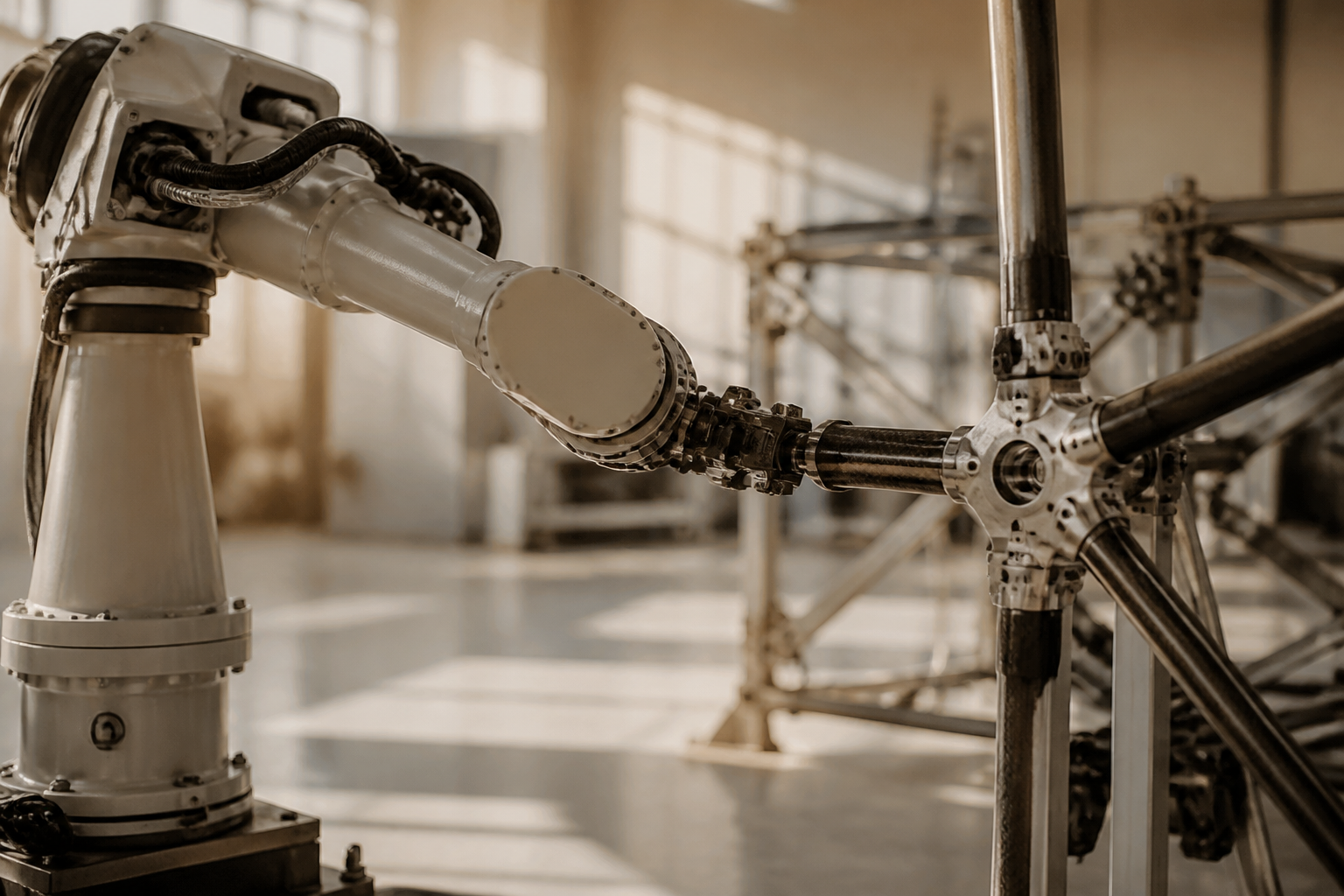
Caltech Space Robot Successfully Assembles Antenna Frame in Orbit
Researchers at Caltech tested an autonomous robot operating in Earth orbit that successfully assembled a section of an antenna frame. The system dispenses composite tubes and metal joints to construct structures larger than typical rocket payloads. Remote engineers adjust operations by testing solutions on a twin robot located on Earth.
The Blend
Engineers at Caltech, supported by DARPA funding, have demonstrated an autonomous space robot capable of assembling hardware directly in Earth orbit. The experimental machine, known as the ASTRA project, used robotic arms to collect composite tubes and metal connectors to build a section of a structural frame without human intervention in space. While time constraints prevented the system from completing its full antenna assembly during the mission, the test successfully validated the core concept of autonomous orbital construction.
Launching complete, giant structures into space has always been limited by the physical size of rocket payload fairings. Building hardware directly in orbit allows space agencies and commercial companies to bypass these design bottlenecks, enabling the creation of massive satellite antennas, space telescopes, and solar power arrays. Shifting assembly work from humans to autonomous robots also reduces mission risks and operational costs significantly, as astronauts are not required to perform tedious or dangerous space walks to assemble components.
Despite this milestone, operating complex automated systems in the harsh vacuum of space presents ongoing challenges, particularly regarding long-term reliability and mechanical wear. While Caltech researchers relied on a matching ground robot to troubleshoot issues, it remains uncertain how quickly fully autonomous orbital construction can scale to routine commercial deployment. Moreover, as satellite swarms and orbital debris grow rapidly, establishing clear international rules for automated manufacturing in shared orbital paths will be critical before high-volume space construction becomes commonplace.
Written independently by AI News Smoothie from the reporting listed below. Facts belong to the original publishers. Follow the links for their full coverage.
Ingredients
- Caltech Robotic Space Demo Successfully Builds in Space
-
www.caltech.edu
Caltech researchers demonstrated an autonomous orbital builder that assembled structural truss components in space.